Jan 14, 2026 • 3-4:30pm
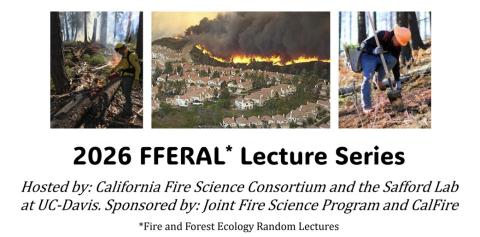
Lecture | 2026 FFERAL Lecture Series
Details
Wickson Hall 1017 UC Davis or via Zoom
CA
United States
Recording
Description
Land managers and practitioners need reliable, empirical evidence about which forest treatments reduce wildfire impacts—and how long those benefits persist. This seminar introduces a framework designed to meet that need. Part 1 presents findings from Yackulic et al. (2025), which use a natural-experiment design in the Central Sierra to show how thinning and prescribed fire reduce biomass loss moderate fire severity, and improve forest retention. Part 2 highlights expanded methods now applied across regions, treatment types, and ecosystem processes. By integrating extensive treatment records with remote-sensing time series and counterfactual controls, we quantify treatment effectiveness over its full lifespan—from changes in fire behavior to shifts in ecosystem water use and post-fire recovery. These results offer tangible performance metrics that can inform project design, build trust in proactive management, and support multi-benefit planning at landscape scales.
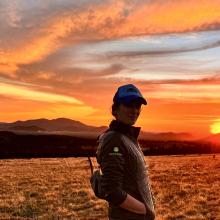
Katharyn Duffy, PhD
Presenter
Dr. Katharyn Duffy is a Senior Scientist at Vibrant Planet and an Adjunct Faculty member in Ecoinformatics at Northern Arizona University. Her work integrates empirical observations, remote sensing, and ecological data science to quantify the realized effects of forest management interventions across Western landscapes. Her group’s research focuses on how fuel treatments and fire use restore ecosystem function, influence wildfire severity, and change recovery trajectories across a range of potential measures including forest retention, ecosystem water use, and drought resilience. Dr. Duffy collaborates with federal, state, tribal, and community partners to integrate evidence-based approaches into proactive management, multi-benefit planning, and climate-resilient forest stewardship in California and beyond.