Displaying 31 - 40 of 113
-
The California Fire Science Consortium (CFSC) strives to accelerate the awareness, understanding, and adoption of fire science information by decision-makers across the region. Applying research to land management decisions can be challenging due to limited actionable findings, information overload, researcher-practitioner disconnects, and findings that don’t always align with local conditions.
-
Participants will learn about fire behavior in our local vegetation types and how to function as an effective burn crew memeber.
-
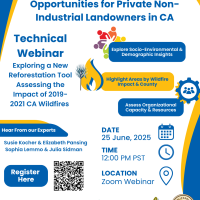
Join us to explore a new tool developed by American Forests and the University of California Cooperative Extension that supports post-fire reforestation planning across California’s non-industrial private forestlands (NIPF).
-
In this webinar, we will discuss how Behave v7 differs from BehavePlus v6 by highlighting the Surface, Surface/Crown, Surface/Mortality, and Surface/Contain modules and enhancements that will be included in the next few releases in 2025-2026. This webinar will be useful for both burn bosses and RX-300 cadres. This webinar will be most useful for both burn bosses and RX-300 cadres.
-
In this webinar, we will discuss how Behave v7 differs from BehavePlus v6 by highlighting the Surface and Surface/Crown modules and enhancements that will be included in the next few releases in 2025-2026. This webinar will be most useful for fire analysts, S-390 cadres, and S-490 cadres.Presented by: Faith Ann Heinsch (RMRS Development Lead) and LaWen Hollingsworth (RMRS Fire Behavior Specialist)
-
Wildfires are ubiquitous and an integral part of the Earth System. Although they can be a destructive force, they are vital for maintaining the biodiversity and functioning of many ecosystems. Wildfire-induced changes in vegetation and landscape properties also have important feedbacks to climate through modulating water- and energy-exchanges and the carbon cycle.
-

Join CFSC PI, Lenya Quinn-Davidson, for a continuation of the Fish and Fire conversation at the upcoming Fish and Fire 2025 Workshop, which will take place during the 42nd Annual Salmonid Restoration Conference.
-
Following an unprecedented period of fire exclusion in many western North American forests, wildfires are not only returning but also increasing in their area burned and severity. These trends are expected to intensify under climate change. However, recent research on reburned landscapes reveals strong negative feedbacks on future fire severity through the process of burning and returning landscapes.
-
After a successful fire workshop tailored for cooperative extension professionals in Raleigh, North Carolina last year, we are taking the workshop on the road!
-

Wildfires are a major driver of biodiversity patterns globally. In many ecosystems of North America, fires are becoming increasingly frequent and/or severe due to a combination of past land management practices and climate change. These shifts are likely to impact plant and animal populations and communities in complex and perhaps surprising ways.